Why American Cyclists Keep Having Their Best Days on the Other Side of the World
Ask any American cyclist who's raced or trained in Baku, and they'll tell you the same thing: something just clicks over there. Not in a vague, hand-wavy way — in a concrete, measurable, what-just-happened kind of way. Watts go up. Tactics sharpen. The mental chatter quiets down. And the performances that seemed just out of reach back home suddenly become real.
So what's actually going on?
The Comfort Zone Is Costing You More Than You Think
Let's start with something sports psychologists have been saying for years that most cyclists still haven't fully internalized: familiarity breeds complacency.
Dr. Renata Voss, a performance psychologist who works with endurance athletes across the US, puts it bluntly. "When athletes train and race in the same environments repeatedly, their brains start running on autopilot. The stimulation drops, and so does the ceiling for what they believe is possible."
Baku breaks that autopilot hard. The streets are different. The competition is different. The food, the culture, the time zone — all of it forces your nervous system to wake back up. And when your brain is paying attention again, your body tends to follow.
This isn't just anecdotal. Research on what's sometimes called "environmental novelty" in performance settings suggests that unfamiliar surroundings can elevate focus, increase dopamine-driven motivation, and reduce the kind of low-grade anxiety that accumulates when athletes feel like they're perpetually being watched and judged by their home community.
In Baku, nobody has pre-loaded expectations of you. That's more valuable than it sounds.
New Competition, New Ceiling
One of the biggest performance killers in American domestic cycling is a subtle one: riders spend so much time racing the same fields that they mentally cap themselves against known competitors.
You know the guy who always beats you at the Tuesday night crit. You know the woman from the local team who always gaps you on the climb outside of town. That mental library of "what's possible" gets written by your local competition — and it's often written too small.
Baku's international racing scene blows that library up.
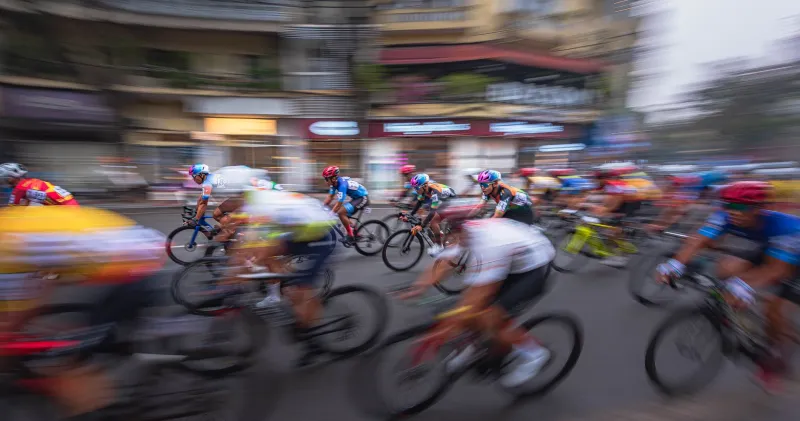
When you're suddenly lining up against riders from Central Asia, Eastern Europe, and the Middle East — athletes whose styles, strengths, and tactics you've never encountered — your brain can't fall back on its usual scripts. It has to improvise. It has to actually race.
Coach Marcus Trelawney, who has guided several US-based competitive cyclists through their first Baku campaigns, says the tactical evolution he sees in a single week of international racing there often outpaces months of domestic development. "They come back thinking differently. Not just fitter — smarter. They've had to solve problems on the bike that their usual races never threw at them."
The Mental Freshness Factor
There's another dimension here that doesn't get talked about enough: mental fatigue.
Elite and competitive amateur cyclists in the US often carry enormous psychological loads. The pressure to perform for sponsors, coaches, local clubs, and social media audiences creates a kind of chronic low-level stress that's hard to escape when you're sleeping in your own bed and training on your own roads.
Travel — real travel, not just a drive to the next state — provides a hard reset that's genuinely difficult to manufacture at home.
Riders who've made the trip to Baku consistently describe a sense of mental spaciousness that surprises them. Away from their usual obligations and social pressures, they find they're able to focus on the actual process of riding and racing in a way that feels almost rare. The ride is the thing again, not the content around it.
"I stopped looking at my phone between stages," recalls one US amateur racer who competed in Baku last season. "There was too much to see, too much to experience. And I think that gave my head a rest it didn't even know it needed. My legs felt it within two days."
Cultural Immersion as Performance Tool
Baku isn't just a backdrop — it's an active ingredient.
The city sits at the intersection of the ancient Silk Road and a rapidly modernizing 21st-century metropolis. That combination produces an energy that's genuinely hard to find anywhere else. Old city walls a few blocks from gleaming F1-grade street circuits. Caspian Sea breezes rolling in while you climb through the surrounding hills. A cycling culture that takes the sport seriously in ways that feel different from the American experience.
Immersing yourself in that environment does something to your relationship with cycling itself. Riders talk about reconnecting with why they started riding in the first place — the adventure of it, the exploration, the physical conversation with a landscape that doesn't care about your Strava segment times.
That reconnection has real performance implications. Athletes who are intrinsically motivated — who ride because they love it, not just to hit numbers — consistently outperform those running on external validation alone. Baku has a way of nudging riders back toward that intrinsic place.
What Actually Comes Home With You
Here's the part that matters most: the gains aren't left behind at the airport.
The tactical intelligence earned from racing an international field transfers directly to domestic competition. The mental freshness, once experienced, becomes a reference point — athletes know what it feels like to perform without the weight of accumulated pressure, and they can start building habits to recreate that state at home.
And the physical adaptations — built through varied terrain, competitive intensity, and the kind of training load that unfamiliar environments naturally inspire — are as real as any numbers on a power meter.
Coach Trelawney puts it this way: "The riders who go to Baku don't just come back with a result. They come back with a new model of what they're capable of. And that model changes everything that comes after."
The Silk Road has always been about exchange — ideas, goods, culture moving between worlds. For American cyclists, what travels back from Baku turns out to be something that no training plan or local race series can fully replicate: a genuine expansion of what they believe is possible.
Sometimes you have to go very far from home to find out who you actually are on a bike.