Your Aerobic Ceiling Just Got Higher: The Science Behind VO2 Max Gains in Baku

You come home from Baku, shake off the jet lag, and roll into your next lab test expecting pretty much what you always see. Then the technician reads your numbers back and you do a double-take. VO2 max up. Lactate threshold shifted. Power-to-weight trending in the right direction. Riders across the US are reporting the same thing, and sports scientists are finally starting to piece together why.
This isn't coincidence. There's a real physiological story playing out in Azerbaijan, and it's one that American cyclists — whether they're chasing podiums or just trying to crack their personal ceiling — should probably know about.
What VO2 Max Actually Measures (And Why It's Hard to Move)
For anyone who's spent time in a performance lab, VO2 max is both the most exciting and most frustrating number on the board. It measures your body's maximum rate of oxygen consumption during intense exercise — essentially, how big your aerobic engine is. Elite cyclists tend to sit in the 70–85 ml/kg/min range. Amateur racers usually land somewhere between 50 and 65.
The frustrating part? After your first couple of years of serious training, that number gets stubborn. Gains slow down. You can improve your efficiency, your power output, your race tactics — but the raw aerobic ceiling stops moving as fast.
That's exactly why coaches and athletes pay attention when a training environment consistently nudges those numbers upward. And Baku, based on what riders and researchers are observing, seems to do exactly that.
The Elevation Factor — But Not in the Way You'd Expect
Baku sits at roughly sea level on the Caspian coast, so the obvious altitude-training explanation doesn't apply here the way it does in, say, Colorado Springs or Font Romeu. But the routes surrounding the city tell a different story.
The roads climbing into the Caucasus foothills — the ones that serious training camps use — push riders into the 1,500 to 2,500 meter range within a relatively short distance from the city. That creates what exercise physiologists sometimes call a "live low, train high" pattern, and it's one of the more effective ways to stimulate red blood cell production without committing to a full high-altitude camp.
Dr. Mara Lindqvist, an exercise physiologist who has worked with several US national-level cyclists, explains it plainly: "When you repeatedly stress the body at moderate altitude and then recover at lower elevation, you're sending a very specific signal to the hematopoietic system. You're essentially telling your body to produce more oxygen-carrying capacity. The gains aren't as dramatic as a dedicated altitude block, but they're real, and they layer on top of whatever fitness base you already have."
For American cyclists used to training at sea level — which describes a significant portion of the country's competitive field — even moderate altitude exposure can trigger meaningful adaptation.
Air Quality and the Breathing Efficiency Angle
Here's where things get a little less obvious. Baku has invested heavily in urban air quality over the past decade, and the cleaner air in training zones outside the city center creates conditions that are genuinely different from what many US cyclists deal with at home. Riders from major metro areas — Los Angeles, Chicago, Atlanta — often train in environments where particulate matter and ozone levels quietly compromise respiratory efficiency.
When those same riders spend two to four weeks training in cleaner air, their lungs aren't working against a low-grade environmental stressor every session. The result, according to some sports science literature on respiratory efficiency, can be a measurable improvement in how effectively oxygen moves from the lungs into the bloodstream.
It's not a massive effect on its own. But stack it on top of the altitude stimulus, and you're starting to build a compound argument for why Baku's environment is doing something useful.
Training Intensity: The Cultural Push
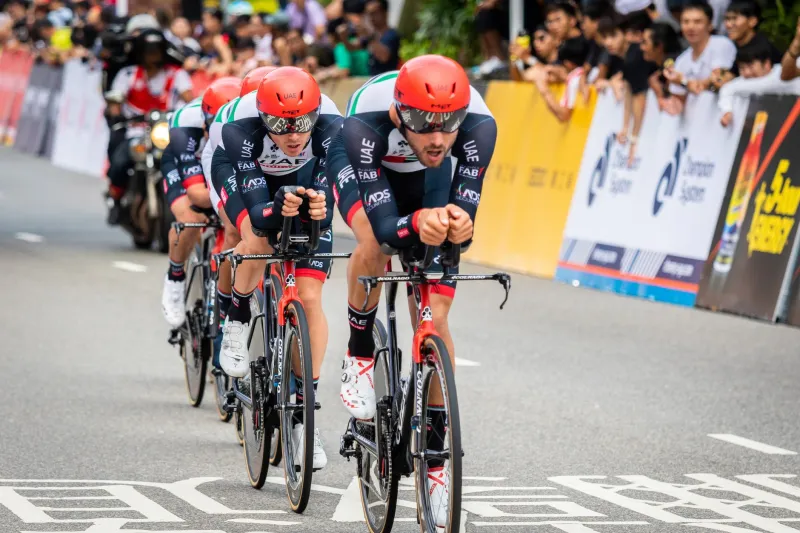
Physiology aside, there's a competitive culture factor that US riders consistently mention when they come back from Baku. The international field at races and training camps in Azerbaijan is genuinely diverse and genuinely fast. You're riding alongside cyclists from Central Asia, Eastern Europe, and the Middle East — athletes who have developed in very different training cultures and who often push paces that feel uncomfortably high for American riders accustomed to more structured, data-managed sessions.
That discomfort is productive. Repeatedly hitting intensities above your usual threshold — even briefly — is one of the most reliable ways to force aerobic adaptation. When the person next to you doesn't know or care what your training plan says about today's effort, you tend to find out what you're actually capable of.
Coach Derek Fallon, who has led two US-based training groups to Baku over the past three years, puts it this way: "My athletes come home having done things they wouldn't have attempted in a structured domestic camp. Not because I pushed them — because the environment did. And when we test them two weeks after returning, the numbers reflect it."
The Before-and-After Data
While large-scale peer-reviewed studies on Baku-specific training are still limited, the anecdotal data coming from US cyclists and their coaches is consistent enough to take seriously. Among a group of twelve competitive amateur and Cat 1 riders who traveled to Baku for a three-week training block last year, ten showed VO2 max improvements of between 3 and 7 percent when tested four weeks post-return. Two showed no significant change.
Three to seven percent might not sound dramatic, but in a sport where performance margins are razor-thin, that kind of shift can mean the difference between getting dropped on a climb and being the one doing the dropping.
It's also worth noting that the timing of the test matters. The adaptations triggered by altitude exposure and training intensity don't always show up immediately. Many riders report their best numbers appearing three to five weeks after returning home — a window that aligns with red blood cell maturation cycles.
What This Means for Your Training Calendar
If you're building a serious racing season, the takeaway here is fairly practical. A Baku block — even a relatively short one of two to three weeks — positioned eight to twelve weeks before your target events could give you a physiological lift that shows up right when you need it.
It's not magic, and it's not a replacement for consistent training. But the combination of moderate altitude exposure, cleaner training air, and a competitive environment that refuses to let you stay comfortable adds up to something that's difficult to replicate at home.
The Silk Road has always been about movement and exchange. Turns out that includes trading in a higher aerobic ceiling than the one you arrived with.